
02 · Sales AgentProduct
An autonomous agent that runs outbound — and stays in Slack
AI · Sales
Enrich leads, write and follow up by email, hand off for calls, learn in Slack, and answer from a living knowledge base.
01 · Challenge
Outbound sales stalls when enrichment, first touch, follow-ups, and product knowledge live in five tools — and nobody updates the CRM.
02 · Move
Ship an AI sales agent that owns the loop: enrich leads, write and follow up by email, hand off when a call is needed, learn from the team in Slack, and answer from its own knowledge base.
03 · Result
Working product: create a prospect, assign an agent persona, auto-contact, pipeline answers in Slack, and a knowledge layer that absorbs product updates for the next prospect question.
The case
Outbound fails in the gaps between tools. Enrichment in one tab. Sequences in another. Product answers in a Notion doc nobody opens. CRM fields that stay empty because updating them is a second job.
We built an agent that owns the loop instead of decorating it — and that stays where the team already works: email for prospects, Slack for the company.
The job
A sales agent is only useful if it can start a conversation, keep it warm, and know when to step aside. That means enrichment before the first line, a persona that holds tone and language, a follow-up cadence that does not forget, and a clean handoff when a human call is the right next move.
It also means product knowledge that does not rot. When the team ships a pricing change or a new feature, the agent should absorb it — then use it on the next prospect question without a prompt engineer in the middle.
How the agent works
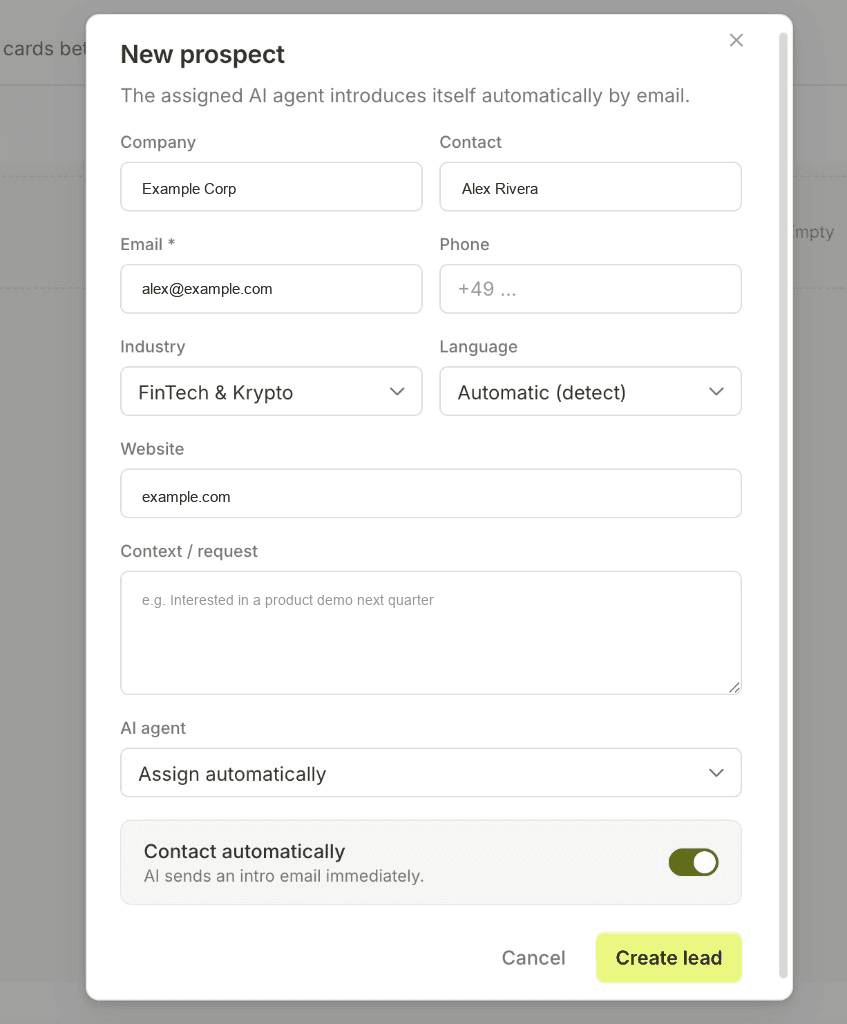
Create a prospect. The agent enriches company, contact, industry, website, and context — enough for a sharp first touch. Assign a persona: voice, mailbox, instructions. Contact runs automatically.
Email is the prospect channel. Follow-ups stay on schedule. If someone asks for a call, the agent hands off to a colleague with the full context attached.
Inside the company, Slack is the control room. Ask for pipeline status. Drop product updates. The agent learns from those messages and answers the next prospect from its knowledge base. Screens here use placeholder company and contact data.
Why we built it this way
Sales automation that ignores handoff and knowledge becomes spam with better grammar. This agent is designed around the moments that actually close deals: a relevant first touch, disciplined follow-up, a human when needed, and answers that match what the product is today.
The same idea works beyond sales: give the agent one clear job, keep the loop visible, and put people where judgment changes the outcome.
How it runs
- 01Enrich leads
Company, contact, industry, website, context — enough signal for a sharp first touch without a research intern.
- 02Write & follow up
The agent introduces itself by email, follows up on schedule, and keeps tone/language from its persona.
- 03Hand off to humans
When a prospect asks for a call, the agent passes to a human colleague — with context, not a cold lead dump.
- 04Slack + knowledge
Talk to the agent in Slack for pipeline status. It learns from team updates and answers prospects from its knowledge base.
Product screens
New prospect — enrich, assign, contact automatically 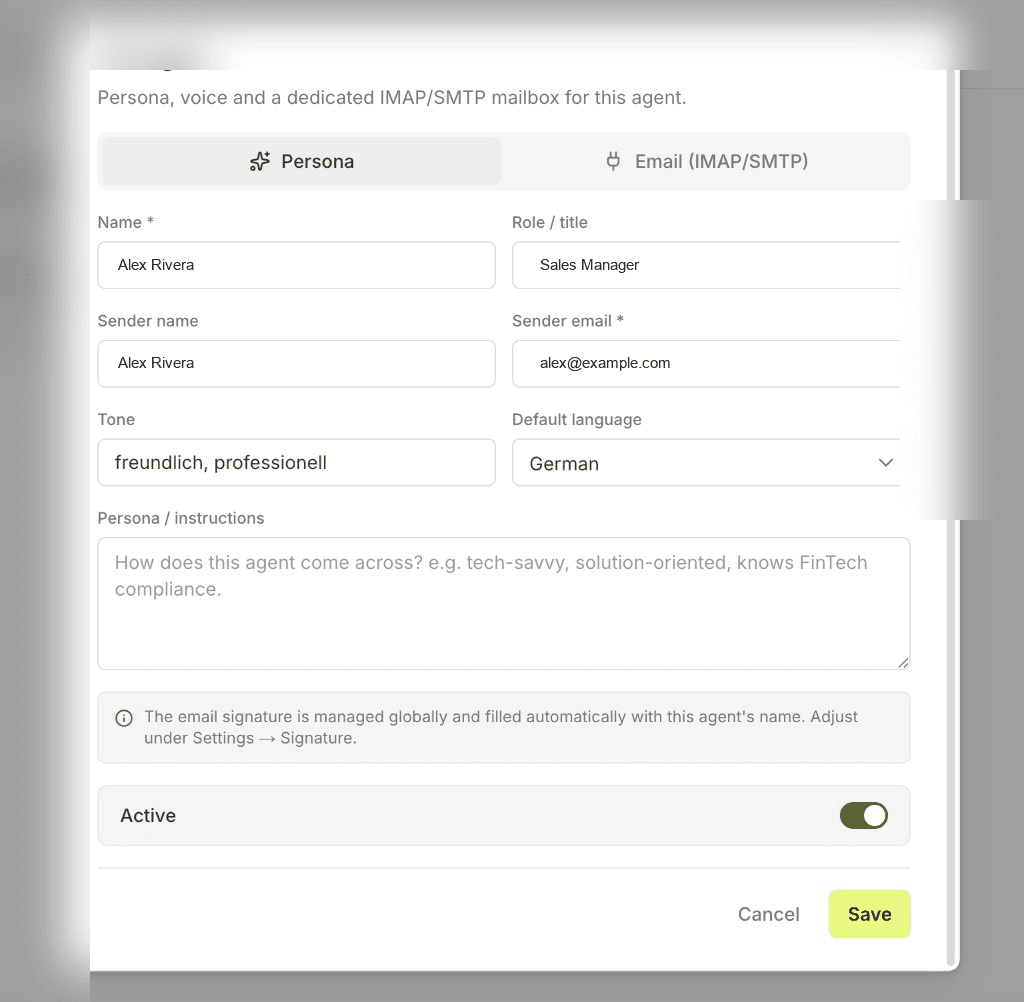
Agent persona — voice, mailbox, instructions 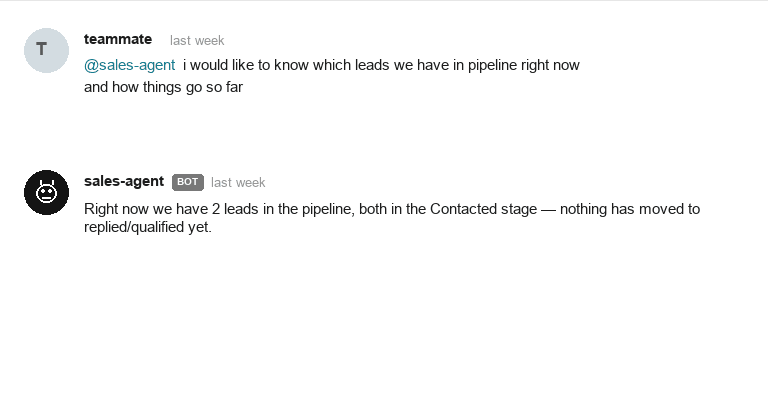
Slack — ask the agent about the pipeline 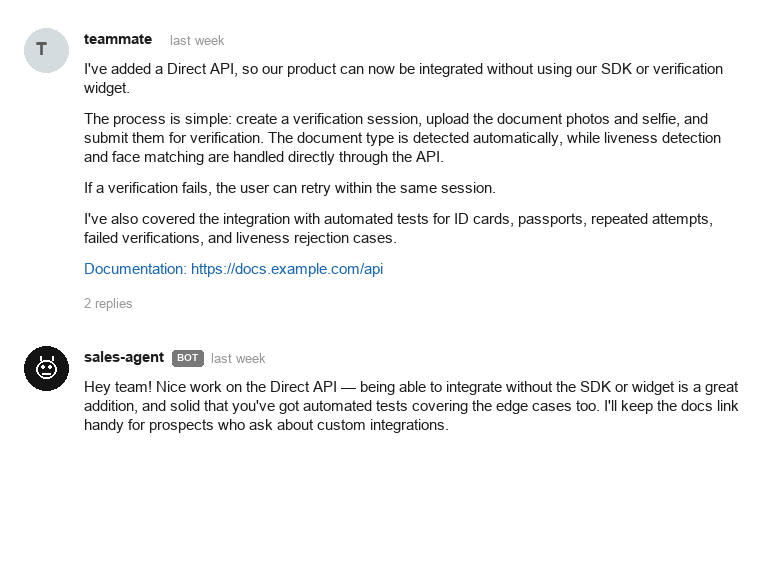
Slack — the agent learns from team updates